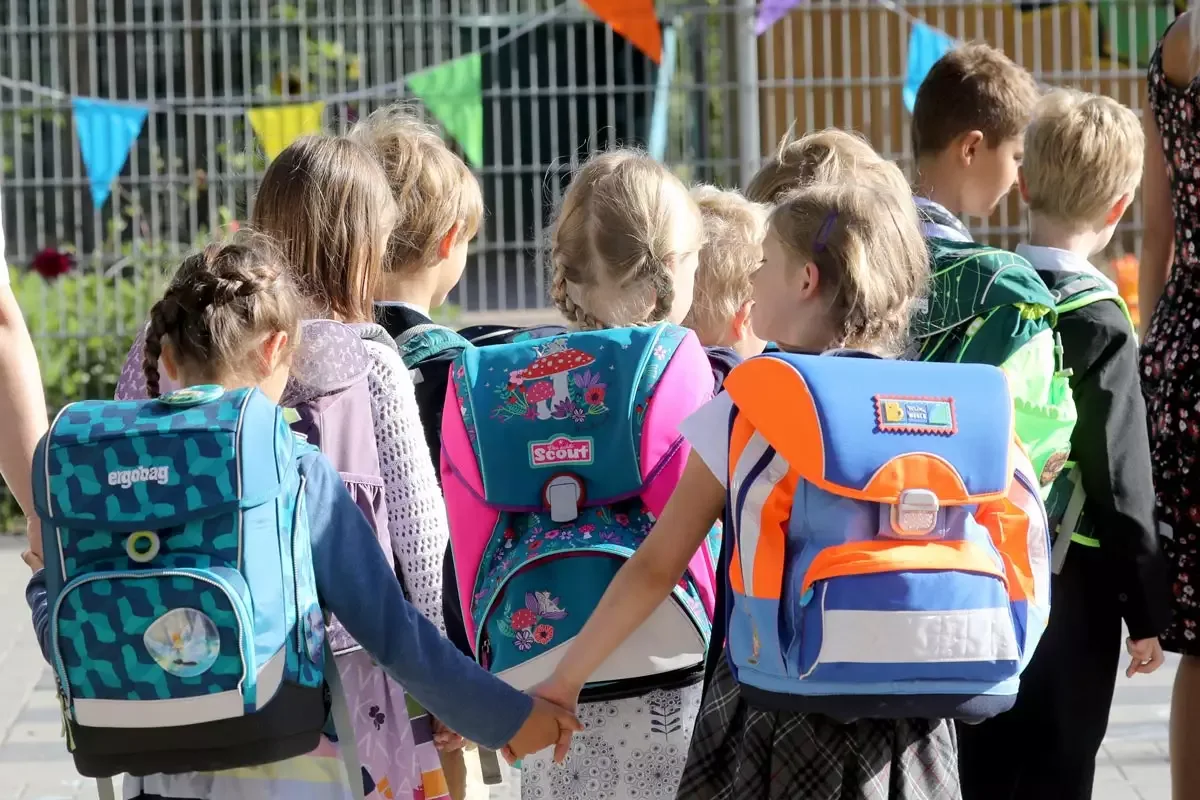
If you are moving to Switzerland with children this summer, the calendar is working in your favour. In most German-speaking cantons, the 2026/27 school year begins on Monday 10 August or Monday 17 August — Basel-Stadt, St. Gallen, Aargau and Thurgau are in the first wave; Zurich, Lucerne, Zug, Graubünden and most of central Switzerland follow a week later. A few cantons start later still: Valais on 20 August, Fribourg on 27 August, Ticino on 31 August. Exact dates can vary by municipality, so check your commune's school calendar.
The good news up front: you do not need to have anything arranged before you land. Swiss public schools are legally obliged to take your child in — and they are used to children arriving mid-year from all over the world.
What the system expects from you
School attendance is compulsory in Switzerland from age four, and compulsory schooling lasts eleven years — two years of kindergarten are part of it, which surprises many newcomers. Nearly all children in Switzerland attend the public school in their municipality, and attendance carries no tuition fees: Article 19 of the Federal Constitution guarantees adequate basic education at no charge to parents.
Your part is simple but time-sensitive:
- Register your arrival with your municipality first. You have 14 days from moving in (8 days in the canton of Vaud). This registration is the key that unlocks everything else, school included.
- Then contact the local school administration without delay. Depending on the canton this is the Schulverwaltung, the Kreisschulbehörde or simply the school listed on your municipality's website. Your municipality of residence must admit your child from the start of your residence — this is not a favour, it is an obligation.
What happens next
Taking Zurich as an example — the process is similar elsewhere — the school leadership invites you and your child to an intake conversation within days of your registration. You discuss your child's previous schooling, languages and needs. Placement is by age group: a child is placed with children of the same age, and a lack of German alone is not a reason to put them in a lower class. At most, placement one year down is possible.
For children who do not yet speak the local language, there are two established models. Many schools integrate children directly into a regular class and add intensive German-as-a-second-language lessons (DaZ) alongside. Some municipalities run separate intake classes for grades 2 to 9, where children spend up to a year focused on the language before joining a regular class. Which model applies depends on your municipality — ask at the intake conversation.
What this means for your planning
If you arrive before mid-August, your child can plausibly start with everyone else on day one — a real advantage socially. If you arrive later, do not worry: children join classes throughout the year, and the intake process is the same. The one mistake to avoid is waiting. Enrolment runs through your municipality, so the sooner your registration is done, the sooner your child has a desk.
One canton is not the next: school start dates, intake models and even the structure of kindergarten differ. Your municipality's school administration and the cantonal education office are the authoritative sources for your specific situation — when in doubt, ask them directly.
And a quiet reassurance from parents who have done this before you: Swiss public schools have decades of experience integrating newly arrived children. In Zurich alone, parent information is available in 29 languages, and intercultural interpreters can be brought into the intake conversation. Your child will not be the first in the class who arrived without a word of German — and by spring, you may be surprised who is correcting your pronunciation at the dinner table.
Sources: aboutswitzerland.eda.admin.ch (compulsory schooling), Canton of Zurich Volksschulamt (enrolment of newly arrived children), cantonal school holiday calendars 2026/27 · Status: 8 August 2026 · This article was written with AI support.